Showing posts with label Honda EV. Show all posts

Tuesday, April 19, 2011

Honda says it will make electric cars in China

Honda plans to build make electric cars in China starting next year 2012 as part of a plan to raise sales there 10% a year.

Honda, a Japanese automaker, isn't stopping at electrics in the drive to pout China on the forefront of the automotive revolution, Bloomberg News reports. It also will make hybrids eventually, Bloomberg quotes CEO Takanobu Ito as saying at the Shanghai auto show today.

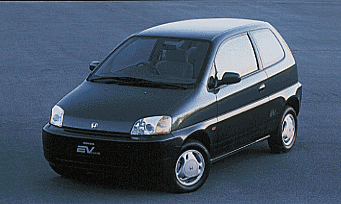
It's not like Honda will have to ship in a lot of parts for the project. The batteries, motors and other core parts are already made by Chinese manufacturers to cut procurement costs, he said. It's unclear which car that Honda would use as a base, but it has announced plans to electrify the small Fit. That's an electric fit in the picture, above.

Honda expects to sell 730,000 vehicles in China this year, a growth rate of about 10%, Ito said.

Source;
http://content.usatoday.com/communities/driveon/post/2011/04/honda-says-it-will-make-electric-cars-in-china/1

Thursday, February 3, 2011

Honda EV retro Sedan?

You might remember this vehicle shown as a prototype a few years ago in a Coupe style, well, this looks like a nice close to production ready vehicle.... Not sure what, if anything, will come of this....

Great find www.woodyscarsite.com
Source;
http://www.woodyscarsite.com/2011/02/retro-ev-honda-is-back-and-4-doors.html

Monday, December 20, 2010

Honda trials solar-powered EV charging station in Japan

One of the main problems that electric vehicles (EVs) face is that lack of support infrastructure. You wouldn’t want to drive interstate only to find that there isn’t a charging station for your EV in the area. Honda’s vision for a solar-powered home-based hydrogen production station is an effort to ease the transition from fossil to alternative fuels. The company has since revealed plans to trial a solar-powered public EV charging station. The program will be tested over in Japan and the ultimate goal of it is to achieve what Honda calls Total Energy Management, which is a system that supplies households and communities with energy for personal use, while supporting a comfortable low-carbon lifestyle.

Source;
http://ubergizmo.com/2010/12/honda-trials-solar-powered-ev-charging-station-in-japan/

Honda Uses Toshiba Lithium-Ion Batteries in Test Version of Electric Car

In China first....
Honda Motor Company is using lithium-ion batteries made by Toshiba Corp. in a test version of its electric car, expanding upon a supply agreement for electric scooters.

Honda’s joint venture with Kyoto-based GS Yuasa Corp. will supply lithium-ion batteries for its hybrid cars, including a plug-in vehicle, while Toshiba’s packs may be more suitable for all-electric cars, which require more power, Tomohiko Kawanabe, head of Honda’s research and development division, told reporters today in Saitama prefecture, north of Tokyo.

Japan’s second-largest carmaker unveiled the test versions of its electric car and plug-in hybrid today, joining Toyota Motor Corp. and Nissan Motor Co. in efforts to meet tighter government emissions rules. Honda has supply agreements with four battery makers, including Panasonic Corp. and its subsidiary Sanyo Electric Co., which make nickel-metal hydride packs for Honda’s current hybrid cars.

Honda’s electric car can go more than 160 kilometers (100 miles) on a single charge, farther than Nissan’s Leaf electric car, Tokyo-based Honda said today. The plug-in hybrid can run 25 kilometers on battery power before the gasoline engine kicks in, about the same as Toyota’s plug-in. The figures are based on Japanese highway testing methods.

Honda rose 1.6 percent to 3,285 yen as of 2:29 p.m. in Tokyo trading, extending its gain this year to 5.6 percent.

Nissan’s Leaf

The carmaker hasn’t decided whether it will use Toshiba’s batteries for mass production, Kawanabe said. Toshiba already makes lithium-ion batteries for Honda’s EV-neo electric scooter, which it started leasing to corporate customers this month.

The company is also seeking to sell batteries made by Blue Energy Co., the venture with GS Yuasa, to other carmakers to help lower costs, he said.

Nissan, Japan’s third-largest automaker, starts selling its lithium-ion battery-powered Leaf hatchback this month in Japan and the U.S. and will begin selling it in Europe next year. Chief Executive Officer Carlos Ghosn has estimated that electric cars may account for 10 percent of global auto sales by 2020.

Toyota plans to sell a short-distance pure electric car and a plug-in hybrid by 2012.

Saturday, December 18, 2010

Electric Honda Fit Hits The Road In CA, Accord Plug-In Hybrid To Follow

Well, that was quick. Just one month after it unveiled the electric Fit EV prototype at the Los Angeles Auto Show, Honda is about to put the first of its electric subcompacts into daily use in southern California.

Amusingly, it's in Torrance, where rival automaker and hybrid leader Toyota has its U.S. headquarters.

The city of Torrance will receive a Honda Fit EV to test early next year, and then in 2012, a Honda Accord sedan fitted with Honda's new plug-in hybrid powertrain as well. Stanford University and Google will also receive their own Fit EV test cars.

In Torrance, the cars will be used by various city departments, including the Economic Development office, the Community Development department, and the Public Works office.

The president and CEO of American Honda Motor Co., Tetsuo Iwamura, took part in a ceremony with Torrance mayor Frank Scotto to hand over a symbolic Honda key. Honda's demonstration program will give the company real-world data on how drivers use both electric and plug-in hybrid vehicles.

The all-electric Honda Fit EV will be launched in 2012 in the U.S. and Japan, probably as a 2013 model. Its lithium-ion battery pack gives it a range of up to 100 miles (70 miles when applying EPA's adjustment factor), and Honda quotes a top speed of 90 miles per hour.

Source;
http://www.greencarreports.com/blog/1052617_electric-honda-fit-hits-the-road-in-ca-accord-plug-in-hybrid-to-follow

Tuesday, November 9, 2010

Honda stresses product, tech blitz to get back on track

Honda Motor Co. survived the global financial crisis better than most, avoiding the full-year losses seen on many balance sheets. But Honda's rebound has not been as sharp as most of the rest of the industry. American Honda's sales rose only 3 percent through September, compared with the 10 percent advance for the U.S. market as a whole. Its market share shrank to 10.6 percent, from 11.3 percent a year earlier.

But Honda Motor CEO Takanobu Ito says new products, led by the redesigned Odyssey minivan, will deliver above-average growth in 2011. A blitz of new technologies is also on tap for the next two years, including a hybrid system for mid-sized to large vehicles, an electric car and a small clean diesel drivetrain. Honda also will start overhauling gasoline engines and transmissions.

Ito, 57, spoke with Asia Editor Hans Greimel through an interpreter at Honda's headquarters in Tokyo about the latest technology drive, the positioning of the Acura brand and Ito's market outlook.

Honda's U.S. sales growth is slower than the industry average. Where will it be next year?

Our sales are slightly below our initial expectations. But for next year we will have help from the new Odyssey, an incredibly strong product [which launched this fall in the United States]. The biggest reason our sales are slightly behind is due to the good growth of Hyundai, especially the Sonata. To counter that, we have plans to make the Accord and Civic far more attractive. So for next year, we should be able to get sales growth above the market average.

Has the traditional rivalry between the Honda Accord and Toyota Camry turned into a three-horse race with the Hyundai Sonata?

It has become a competitor.

What models do you see delivering the biggest U.S. sales growth?

The segment that's showing relatively good growth is the light-truck category. And under those circumstances, we are introducing the highly competitive new Odyssey, for which I have high expectations.

The styling looks really sharp. And it comes equipped with a six-speed automatic transmission and our original cylinder deactivation system, which is a big contributor to fuel efficiency and has been further refined. So it combines good driving, good fuel efficiency and good looks. And this has all been developed in the United States by Americans for the American market. I'm very confident that with the Odyssey, we've come out with a good car at the right time.

What about small cars? Are Americans ready to buy them?

With overall demand in such severe shape, it has become difficult to forecast how acceptable the market finds small cars. But if you look from a long-term perspective, demand for small cars -- in our case, the Fit class -- will grow. But it may take some time.

Does that apply to hybrids as well? Sales have been sluggish this year.

Although American people talk about fuel economy, they are sensitive to the price of gasoline. They have the natural tendency to like something big and powerful. Therefore, my impression is that demand for technologies specializing in fuel economy, such as hybrid vehicles, would be impacted by the fuel price.

However, in the long run, we must reduce carbon dioxide, and we must increase the attractiveness of products, and hybrid technology has great potential here. Hybrid is a very good technology to make the vehicle more powerful and to increase fuel economy. I think it is important for us to continue refining our hybrid technologies patiently so that we can prepare even better products with more affordability.

What are you doing to make Honda's hybrids more attractive?

We developed a simple one-motor hybrid system called IMA. The key to the success of IMA is how simple it is, how low the cost can be and how it can be made a natural part of the vehicle's system. I want to grow this technology as the most efficient, in terms of return on investment, and a technology to improve fuel economy.

We are also developing a hybrid system for larger-size vehicles with a goal to make it contribute not only to fuel economy but to the attractiveness of the products. The concept for this hybrid is significantly different.

You are introducing the larger hybrid system in 2012. What percentage of your global sales volume will be hybrid vehicles by 2015?

Maybe around 10 percent by 2015. Even after the bigger hybrids, sales aren't going to grow exponentially. The conventional gasoline engine will remain the mainstream. The volume for large-sized vehicles is not so large to begin with, so applying hybrid there won't bring about major change. The small-sized IMA system will remain the contributing factor.

If you look to 2015, I don't think there will be that much of an impact from rising fuel prices or more stringent regulations. But by around 2020, the social situation surrounding the market may be different, and probably carbon dioxide regulations will be made even more stringent.
How big is a big hybrid in Honda's view?

A hybrid system suitable for the class of vehicle equipped with a V-6 engine is called large size.

Obviously, we will further advance the conventional V-6-equipped vehicles for more power and fuel efficiency. But by adding a hybrid model, we will add a more powerful and more fuel-efficient option.

Honda also plans to overhaul its gasoline engine and transmission lineup starting in 2012. What are the key improvements?

Our products must impress customers with great engines, and thus, that is how we are developing our vehicles. But we are not ready to unveil what we are doing. It is a fact that we are accelerating the development of hybrid technology, where we were slightly behind, because it is a must-have item for the next era. However, hybrid sales will probably be only 10 percent of sales by 2015. Therefore, there is no doubt that the advancement of the conventional engine is important for our business.

What are your plans for positioning the Acura brand?

We are having a lot of discussions about Acura and which way it should be going. And what we confirmed is that the brand direction should be smart premium, not top tier.

Among the technologies we have at Honda, we must apply those that symbolize our advanced performance technology and environmental technology. We call this "smart." We agreed that smart premium is what we should be targeting with Acura, not the upper-segment vehicles such as Lexus or Mercedes-Benz. We must apply advanced technologies which make our vehicle more fun to drive, achieve a more comfortable drive and high environmental performance.

How is the stronger yen affecting Honda, and what are you doing?

The best risk-hedging approach is to establish a business structure focused not only on the United States and Japan but also on utilizing other production sites worldwide, meaning the rest of Asia, China, South America and other areas. Build a system where all those production sites complement each other with some of their local specialty products and locally sold products.

When you think foreign exchange rates, you need to take into consideration the yuan vs. the yen, the yen vs. the dollar, the baht vs. the dollar and so on. Traditionally, we have been concerned mostly with the U.S. dollar vs. the yen. But the proportional weight of those transactions in our global sales volume is getting lower.

Does that mean you might be importing more vehicles or components to Japan?

We have no definitive plans to do that, but we have imported vehicles before. About 15 years ago, we imported the Accord wagon from the United States. This was not due to foreign exchange considerations. It was done more to complement local products.

None of our plants has recovered to full production since the Lehman Brothers collapse and global financial crisis. The U.S. plants are probably at around 80 percent of capacity. Japan is probably around 70 percent to 80 percent. The same applies to other production sites in Asia except for China, which is operating close to full capacity.

Since the financial crisis, none of the sites have been overwhelmed by demand in excess of their capacity. Depending on how the foreign exchange situation continues, it is possible that we could import cars into Japan. This is nothing new to us. We have done this in the past.

What adjustments do you see in your U.S. production footprint in the near term?

The foreign exchange situation has the potential to change very dramatically, when we least expect it. It is very difficult to deal with. Currently, both Japan and the United States have excess production capacity. So if the foreign currency situation continues like this, there is a possibility that there could be a gradual shift of production to the United States. But I have no intention to bring about any sudden, dramatic changes.

What may be possible, for example, is this: We now produce the Accord in Japan and export some to the United States and other countries. But perhaps the portion that is going to other countries may eventually be sourced from the United States. That's something we are thinking about. It would also be good for the United States.

What change would you most like to see in the U.S. dealer network?

We have a good, strong U.S. dealer network, so I'm not thinking of changing anything specifically for 2011, 2012. What's most important is finding out and taking in what U.S. customers really find attractive in products, be it affordability or other features. We need to reinforce that in the early stage and build that into our products to further strengthen our brand identity. That is our first priority.

Source;
http://reviews.cnet.com/8301-13746_7-20022088-48.html

Tuesday, November 2, 2010

Honda CEO sees potential in electric car market

Here's another flip flop on the whole Electric Vehicle stance....
(Reuters) - The head of Honda Motor Co said there could be plenty of demand for battery-powered electric cars, making the strongest endorsement yet of the technology that his predecessor had long shunned as impractical and unrealistic.

Japan's second-biggest automaker announced in July plans to launch a plug-in hybrid and pure electric car in 2012, but had stopped short of laying out a roadmap of how they would contribute to its business.

"It's starting to look like there will be a market for electric vehicles (EVs)," Takanobu Ito, who took over as chief executive last year, told a small group of reporters at a test-drive event north of Tokyo.

"We can't keep shooting down their potential, and we can't say there's no business case for it."

Under Takeo Fukui and other former CEOs, Honda had been a strong proponent of hydrogen fuel-cell cars as the best zero-emission alternative to today's combustion engine cars because they have a similar driving range of 500-600 km (310-375 miles), unlike battery EVs' limited reach.

Nissan Motor Co's Leaf, which will become the world's first mass-volume electric car when it goes on sale next month, can only be driven for 160 km (100 miles) on a full charge since packing more batteries to extend the range would make the car prohibitively expensive.

"The thing is, not everybody needs to drive 500 km a day," Ito said, echoing the argument made by Nissan and its partner, Renault SA, to sell battery EVs in big volumes around the world.

Ito stopped short of predicting how big the EV market could be, and how soon.

But he added that pure electric cars made more sense than plug-in hybrids, which are hybrid cars that carry more batteries that can be charged from an outside source.

"Plug-in hybrids are essentially for people who drive short distances, but it has the handicap of having an engine, a motor and a stack of batteries," he said. "Why wouldn't you just drive an EV?"

In a move that could further accelerate the industry's drive toward EVs, Ito is due to take the wraps off a new electric car concept at the Los Angeles auto show on November 17. It would be the first time for a Honda CEO to unveil a new model at the annual show.

California has some of the world's strictest environmental regulations, and Honda had said it would sell battery-run EVs there only to meet the state's zero-emission requirements.

Japanese rival Toyota Motor Corp, also a recent EV convert, is planning to unveil the electric RAV4, co-developed with Tesla Motors Inc, at the L.A. auto show. Toyota and the California electric car start-up tied up earlier this year, agreeing to develop battery and EV technology together.

Source;
http://www.reuters.com/article/idUSTRE6A11QH20101102

Wednesday, October 27, 2010

L.A. auto show: Honda to reveal electric concept

Honda will unveil an electric-vehicle concept on Nov. 17 at the Los Angeles auto show. It will be accompanied by a new platform that shows off Honda's latest plug-in developments.

Honda Motor Co. Ltd. president and CEO Takanobu Ito will be at the press conference, marking the first time the company's global CEO has made a product reveal in Los Angeles.

The show is expected to feature about 20 global reveals, organizers said on Wednesday.

Source;
http://www.autoweek.com/article/20101027/LOSANGELES/101029900

Thursday, August 5, 2010

Carscoop: SPIED: Honda Civic Hatch Prototype with Full Hybrid System Snagged Testing

Only a few weeks after Honda President Takanobu Ito disclosed plans to equip the next generation of the Civic Hybrid with a new high-output and compact in size, lithium-ion battery, and our spies have captured a pair of test mules in the body of the current, European market Civic five-door hatch, testing near the company's R&D center in Offenbach, Germany.

According to our man with the long lens, the two prototype Civics "left the traffic lights in complete silence", which points to a full hybrid set up with the ability to run on electric power only.

The next generation of the Civic is due for release in 2011 or 2012 the latest. Aside from the hybrid model with gasoline-electric technology which could be offered in Europe in both hatchback and sedan forms, Honda has also confirmed the development of a smaller displacement turbo diesel engine that will fit right under the current 2.2-liter i-DTEC unit.

Source;
http://carscoop.blogspot.com/2010/08/spied-honda-civic-hatch-prototype-with.html

Tuesday, July 20, 2010

Honda to Build Plug-in Hybrids and Electric Vehicle in 2012

Honda Motor Co. president Takanobu Ito at the start of a press conference in Wako near Tokyo Tuesday. Ito said Honda will start selling an electric vehicle as well as a plug-in hybrid in 2012 in the U.S. and Japan. -CBC.ca

Honda was one of the first automakers to sell a hybrid vehicle with the original Insight coupe in 1999, but has since fallen behind in hybrid and electric vehicle technology. According Honda CEO Taknobu Ito, the Japanese automaker aims to correct this in 2012 by introducing a plug-in hybrid and electric vehicle.

In his mid-year address, Ito announced that Honda is preparing a new plug-in hybrid. In addition to developing the plug-in hybrid, Honda is also working on a battery electric vehicle, both of which will be for sale in Japan and the U.S by 2012. Information about Honda's upcoming plug-in hybrid is scarce, but early reports indicate that Honda's plug-in hybrid will be capable of achieving 136 mpg. Reports haven't yet mentioned the car's possible electric-only range.

Honda's interim solution until 2012 is to release products that use its Integrated Motor Assist technology first unveiled on the 1999 Insight. It uses an electric motor sandwiched between the internal combustion engine and transmission to boost fuel economy by reducing the load on the engine, enabling start/stop capabilities, and using regenerative braking. Unlike many newer hybrid systems, IMA can't be fitted to larger vehicles such as Honda's Pilot or propel the vehicle on electricity alone.

Honda's development of a plug-in hybrid and battery electric vehicle for sale in the U.S. and Japan is part of the company's larger push to reduce CO2 emissions. Honda still sees its hydrogen fuel cell FCX Clarity concept as a long-term solution, however, and will continue to develop fuel cell technology.

The new hybrid vehicles have been announced for sale in Japan, but one, the Fit Hybrid, may arrive in the U.S.

Source;
http://rumors.automobilemag.com/6695865/green/honda-to-build-plug-in-hybrids-and-electric-vehicle-in-2012/index.html

Tuesday, June 22, 2010

2011 CR-Z SI or electric versions not in Honda’s plans

Honda’s 2011 CR-Z model will start selling on August 24 in the US. Honda revealed that pricing is estimated to range from under $20,000. (US)

Honda also said that it isn’t planning to produce an Si variant or an electric version of the CR-Z and that a federal tax credit will not be offered with the sporty hybrid coupe. In response to an e-mail query, Honda spokesman Chuck Schifsky said that the CR-Z will not qualify for an alt-fuel federal tax credit because each company is limited to only 60,000 hybrids and Honda hit this number “a long time ago.”

Earlier this month, Honda confirmed during a press conference that a CR-Z Si will not be launched this summer. John Mendel, Honda’s US executive vice president of sales, was asked pointblank if there is a Si variant currently being developed. Mendel replied, “Nothing official.” With regards to the idea of an electric CR-Z, Mendel commented that he “[doesn’t] think” that there are plans to make a purely electric vehicle.

He also said that the success of the pure EV or BEV [battery-electric vehicle] will depend upon the application, charging times and range. Formal pricing information on the CR-Z has not been released yet but Honda executives have said that the CR-Z will be priced from under $20,000, including destination.

A fully equipped CR-Z EX with a navigation system will cost at under $24,000. Honda said that the pricing of the vehicle was kept low because it is equipped with a nickel-metal hydride battery rather than a lithium-ion battery.

Source;
http://www.4wheelsnews.com/2011-cr-z-si-or-electric-versions-not-in-hondas-plans/

Tuesday, June 1, 2010

"In our view, the key to winning this race is not declaring a winner until the technology has actually run the race."

John Mendel
Executive Vice President
American Honda Motor Co., Inc.
American Honda’s Executive Vice President of Sales John Mendel, along with other business leaders and academics, gathered at The Ohio State University May 3 to discuss ways of reducing gasoline in transportation in a three-day conference called: Moving Ahead 2010. Following are his excerpted remarks.

It’s great to be in Columbus... a real hometown for Honda. Our first U.S. manufacturing operations were established here 30-plus years ago … and we have a major R&D center that creates many of the products we build here.

Both our manufacturing and R&D operations have a strong relationship with our host, Ohio State University. We have partnered with OSU in advanced research … we employ their graduates …and our associates root fanatically for the Buckeyes. So, we’re very happy that this important new event is kicking off here.

And this is a critically important event. The realization of more efficient and sustainable forms of mobility is key to the future of our planet … and to the future of personal transportation for millions of people around the world.

It’s also key to the future of the auto industry. I’ve been a part of the industry for more than 30 years now. And I think I can say that for all automakers … the ability to develop advanced environmental technologies is no longer just a means to gain competitive advantage. The truth is that any manufacturer without these technologies will not long survive. And you can look at the mergers and joint technology ventures in our industry over the past year as proof of this new reality.

This pursuit of sustainable transportation solutions amounts to something of a new race for our business, with many promising technologies vying for the lead and various companies racing to bring these technologies to market.

But in our view this shouldn’t be the kind of race where different companies or technologies are pitted against one another. Rather, we should race with each other toward a common goal … of creating technology that provides the world with greater mobility … while dramatically reducing CO2 emissions and creating a more sustainable energy future for generations to come.

"The effort to promote the virtues of one technology should not result in the demonizing of another" In our view … the key to winning this race is not declaring a winner until the technology has actually run the race. That’s a critical distinction, because the race for a cleaner and more sustainable future is a marathon, not a sprint. It will be decades before any new technology can be called the all-out winner. And while there are a lot of opinions … and even more desires … no one can say with certainty today which technology or combination of technologies will be first to the finish line. The effort to promote the virtues of one technology should not result in the demonizing of another. … or in policymakers laying all of their chips on the technology du jour … rather than promoting fair and open competition among all the players and all promising technologies.

This is a crucial point. Because rushing to select a winner could lead us in the wrong direction … resulting in the loss not only of time and substantial investment of development resources … but, more importantly, the trust of our customers and society.

Regulators and legislators at both the federal and state levels should adopt this perspective. To put the country on a course toward a single technology without fully understanding the implications … including whether consumers will buy it … will put us behind in achieving our objectives. And in the long run will be very costly to boot.

Rather, the critical role of policymakers should be to tell industry what goals must be met … a performance standard if you will … and leave it to the industry to figure out how to get there. To do that, we will vigorously pursue a variety of viable technologies for the near-, mid- and long-term to determine which approaches best meet the multiple challenges of air quality … climate change … and energy sustainability.

Certainly, there is a lot riding on the ability of the auto industry to create a new technology pathway. But it would be wrong to believe that the right path to the future of the automobile rests solely with the automakers. Indeed, real progress can not be achieved without the efforts of energy companies, governments and NGOs. And all of us must keep our focus on the customer.

Automakers can’t just build technologically advanced automobiles. We must make automobiles fully functioning … so people want to buy them … and affordable … so people can buy them.

Government can have tremendous influence on this outcome through regulations and energy policies that foster a marketplace that will remain open to a fair competition among the various technologies. This will allow the marketplace to do its job as the ultimate judge of who wins and who loses.

As a case in point, a little more than ten years since Honda introduced America’s first hybrid vehicle, there are some 26 distinct hybrid models on the market … but they still represent just around 2 percent of the total market. And even this level of penetration has benefited from generous incentives from the government and industry.

The reality is that the price of gasoline is the single greatest influence on the sales of more fuel-efficient vehicles including hybrids. If we can’t convince people to move to a hybrid … which is as fully-functioning and as easy to refuel as an internal combustion engine vehicle … we have to seriously consider what will get them to accept battery electric and plug-in hybrid vehicles with their myriad limitations including cost, driving range, and re-fueling or recharging issues.

"We must ultimately replace petroleum as the fuel that powers personal transportation." What we do know … is that we must ultimately replace petroleum as the fuel that powers personal transportation. But accomplishing this challenge requires that we focus on two critical needs … a reduction of petroleum use and a reduction of greenhouse gas emissions. These are related goals in many cases because burning less gasoline reduces CO2 emissions. But the size of that reduction depends on which alternative is adopted and how it is deployed.

Looking at the technology race … will this mean hybrids … plug-in hybrids … biofuel … battery electric vehicles … fuel cell electric vehicles? The answer is … well … “yes.” Because we need to manage short, mid- and long-range demands of society in balance with the evolution of all these technologies. And the reality is that each technology has unique challenges somewhere along that timeline. And even long term solutions require step-by-step progress that must begin today.

So, developing multiple pathways makes more sense than trying to pick tomorrow’s winner today. And by the way, there may well be more than one winner. For instance, we might find that small battery electric vehicles work for commuting … with a fuel cell electric vehicle a better solution for heavier vehicles or for longer trips.

Surely, the internal combustion engine will continue to play a role in personal transportation ... and can be made more efficient. Additionally, bio-fuels represent a great potential alternative to gasoline. But it has to be the right biofuel. The key to the success of biofuels is that we should be able to simply “drop it in” to the existing fleet using the existing infrastructure.

But the drive for bio-ethanol derived from food stocks was a case where prematurely picking a winner may not have made a big contribution to the reduction of greenhouse gas emissions. And while I realize that it was good business for our nation’s farmers, it actually created a host of unintended problems … and undermined credibility with consumers.

Honda is now working on so-called second-generation biofuels – which means the sustainable production of alcohol-based fuels from plant waste material, instead of edible plants. The potential for algae-derived bio-gasoline is also promising because it would offer the additional merit of not needing to change-over cars to run on ethanol…and avoids new infrastructure costs. But these technologies are a long way from mass production.

One of the best alternative fuel opportunities in our grasp today is natural gas. I don’t suggest this to promote the fact that Honda is the only automaker mass-producing a natural gas vehicle … the Civic GX. Natural gas is an inexpensive, clean burning and abundant domestic fuel. The Civic GX is the cleanest vehicle powered by an internal combustion engine that the EPA has ever certified for everyday use. And natural gas results in 25 percent lower CO2 emissions than gasoline.

However, without a convenient and affordable refueling infrastructure natural gas cannot succeed. It’s an important lesson. When it comes to an alternative fuel … no matter how good the technology … no automaker can go down the path alone.

For the near-term, expanded use of hybrid technology represents the best direction to reduce petroleum use … because hybrids leverage both existing internal combustion engine technology and our existing petroleum refueling infrastructure … and represent a bridge to the next generation of electromotive technologies.

But even with hybrids, cost and affordability must continue to be addressed. As I said earlier, there is a strong correlation between hybrid sales and the price of gasoline which demonstrates that consumers are looking closely at the cost benefit ratio … and many still don’t see the overall benefit.

"Honda's strategy is focused on affordability" That’s why Honda’s strategy is focused on affordability, with the goal to make hybrid technology available and appealing to more people.

We have created a family of hybrid models that meet a variety of needs and interests … high fuel economy … a fun-to-drive sporty coupe … and a mainstream family sedan … with additional plans to introduce hybrid technology to our luxury Acura brand lineup in the coming years.

Looking ahead, what will advance and extend the contribution of hybrid vehicles is the introduction of lithium ion battery technology. But improvements in both the performance and cost of batteries are required. Toward this end, Honda has invested in a joint venture to accelerate our ability to introduce lithium ion batteries in future hybrids.

Plug-in hybrids are also being looked to with increasing interest. Certainly, plug-ins would contribute positively to energy sustainability and energy security concerns. But in some areas plug-ins are actually worse than regular hybrids in reducing CO2 emissions.

Also, the larger battery required for a plug-in hybrid vehicle increases the vehicle weight and cost, reducing overall efficiency, while raising additional concerns about battery durability and cost. These issues diminish the payback for a smaller-sized plug-in hybrid vehicle. I don’t mean to suggest that Honda doesn’t believe in plug-ins … with our focus on original technology, we obviously have a few things in the kitchen. But any near-term alternative energy technology we green light for production must offer promise in reducing CO2 emissions and be affordable and practical for the customer.

Of course, there is renewed excitement about battery electric vehicles. And Honda understands electromotive technologies as well as anyone. Starting in 1997, we leased some 340 Honda EV Plus electric vehicles to customers … primarily in California. We developed the EV Plus from scratch as an electric car and it was the first to use non-lead acid batteries.

Looking at real world electric range … which includes the EPA’s 30 percent downward adjustment … our 1997 EV Plus had superior or at least comparable driving range to most of the models now coming “to market.” Fifteen years later, even with the advent of lithium ion batteries, the cost of the battery remains extremely high … as much as half the cost of the vehicle. So, despite legitimate advancements … the technology and the infrastructure remain significant hurdles to high-volume market appeal.

Battery electric vehicles contribute to energy security and the reduced use of petroleum … but like plug-ins they’re not the best solution to reducing greenhouse gas emissions until there are fundamental changes in the nation’s grid. This is a concern shared in other regions of the world. A top executive with a Chinese automaker said just last week that with China deriving 83 percent of its electricity from coal that now is “not the right time to promote pure electric vehicles” in that country.

"Honda is conducting research on a short-distance battery electric vehicle as a 'city commuter car'" There remains hope for the future … and that’s why Honda is conducting research on a short-distance battery electric vehicle as a "city commuter car" – which we see as the practical limit of the technology at the present time. We're now studying the U.S. market with a view to introducing this electric commuter car in the future.

But we continue to believe that a fuel cell electric vehicle is the ultimate solution to reduce CO2 emissions … and meet the real world needs and expectations of consumers. A fuel cell car is a full electric vehicle. But rather than use electricity from the grid, it generates electricity on board.

Among all electromotive technology options fuel cell electric vehicles are about as close to identical to the functionality of existing gasoline-powered automobiles as you can get. As a practical daily driver, the Honda FCX Clarity is a fuel cell electric vehicle with 240 miles driving range … nearly triple that of today’s EVs. And compared to the slow recharging requirements of a battery electric vehicle, the fuel cell electric car can be refilled with hydrogen in minutes. Clarity is also a spacious and comfortable mid-size sedan that has surprised the people who have driven it … including our 15 lease customers in California now driving it on a daily basis.

Importantly, even using natural gas to produce the hydrogen, the Clarity achieves a 62 percent reduction in CO2 emissions. And a 40% reduction versus a battery electric vehicle that uses electricity from the U.S average power grid. For the long-term, we are working on producing hydrogen from renewable sources. One such interesting approach is Honda’s long-term investment to develop a next-generation prototype solar hydrogen station … now operating at our Los Angeles R&D center. This compact system was designed with the idea of daily home refueling of a fuel cell electric vehicle.

Certainly, as with other alternative fuel technologies, fuel cell electric vehicles have challenges to overcome … including a refueling infrastructure and cost reduction. But the full functionality of the vehicle and the potential of a solar hydrogen station are the reasons we view the fuel cell electric vehicle as the ultimate alternative to petroleum … and the best path to reduce CO2 emissions in the long run.

But as I said at the outset … when it comes to alternative fuels, no automaker can be successful without support from energy companies, policymakers and consumers. For fuel cell electric vehicles, there was the promise of a hydrogen highway in California … as well as federal support for fuel cell technology. But this seems to be in constant peril … whether due to the difficult economy or as some new technology comes along. There must be consistent and sustained policy in the near term … to realize the tremendous benefits that fuel cell electric vehicles offer for the long term.

"Policymakers must play an expansive role by defining the goals but not the specific technologies." Policymakers must play an expansive role, not a limiting role … by defining the goals … but not the specific technologies. Government can also contribute through effective energy policies that support both near and longer-tem solutions, and working in partnership with all the key players … while avoiding the temptation to pre-determine the winners and losers before the race has been run.

You know … I realize there is a lot of skepticism about the will and skill of the traditional auto industry to make a real contribution to the reduction of greenhouse gas emissions … and to wean America and the world from its dependence on petroleum. After all, we have earned a reputation … as an industry … as being anti anything the government wanted us to do. Years ago, this actually prompted a quote from our founder Mr. Honda that I will paraphrase for you … he said “when the government passes new regulations, some companies hire 50 more lawyers while Honda hires 50 more engineers.”

I know that the industry CAN lead. Air quality advances over the last 40 years have been nothing short of astounding. And I’m proud to say that Honda led the way … or as some have said … showed the way in meeting virtually every low emission vehicle standard established by the federal government and the state of California.

I’m talking about a thousand-fold reduction in hydrocarbon emissions that the entire industry has now achieved … to the point where we have gasoline internal combustion engines that can achieve credit as Partial Zero Emission Vehicles.

I cannot make the case that this success is an indication of what we can do on every issue … but I think it demonstrates what can be accomplished when the industry and policy makers focus on a key objective. And that’s what we must do now.

The challenges we now face are different … but by entering into a race with each other. by focusing on the same finish line … and by making certain our technology solutions meet the needs of our customers … I know we can advance personal mobility … and protect our planet. And that will make winners out of us all.

Thank you for your attention. And enjoy the rest of the conference.

Source;
http://www.hondanews.com/categories/1346/releases/5459

Thursday, March 4, 2010

Honda at the Geneva Motor Show 2010

HONDA SHOWCASES ZERO EMISSION EXPERTISE WITH 3R-C AND EV-N CONCEPTS
Honda has unveiled two battery electric urban concept cars at Geneva, the stylish EV-N and the three-wheeled 3R-C, which envisions a single occupant vehicle for zero emission commuting. The radical concepts draw on Honda’s expertise in zero and ultra low emission technologies to show two urban vehicles with no harmful tailpipe emissions.

Both, EV-N and 3R-C, build on Honda's vast working knowledge of battery electric vehicles, hybrid electric vehicles and fuel cell electric vehicles. Honda began producing the battery electric vehicle EV Plus in 1996 with the vehicles being leased to selected customers in the US. Since 1999 Honda has been selling petrol electric hybrid cars and in 2008 introduced the world's first production fuel cell electric vehicle, the FCX Clarity.

All of these vehicles utilize electric motors for propulsion and batteries to store power and it is this real-world production experience that Honda is bringing to its latest concept models. Honda's FCX Clarity fuel cell electric vehicle uses a Lithium ion battery to store the energy from regenerative braking and Honda is currently enhancing its expertise in this area. Last-year a deal was signed with GS Yuasa to build a joint venture battery plant to produce Lithium ion battery packs for future Honda vehicles.

EV-N
The EV-N is a battery electric vehicle study, which evokes the spirit of the diminutive 1967 N360 city car. Honda designers have incorporated Honda's own solar panels in to the roof of the concept, to charge the car while it is parked. Two of Honda's U3-X, electric personal mobility devices are attached to the inside of each door. The two-door Concept is envisioned with a Lithium ion battery pack, and small electric motor for predominantly urban use.

The EV-N concept's four-seat interior makes use of the compact dimensions of the battery electric drivetrain, to maximise space and utility, without increasing the vehicles dimensions. The seats of the car have been produced in a mesh finish, which is both very light and easy to change, to make it easy to change the colour and style of the interior, quickly and easily. The interior has been designed in a deliberately minimal style, to reduce the weight of the vehicle, increasing range and performance.

3R-C
This revolutionary three wheeled battery electric vehicle concept shows what a future minimal urban transport vehicle for one person might look like. The battery electric drivetrain, is mounted low in the three wheeled chassis, therefore keeping the center of gravity low and thus improving stability.

The 3R-C has a clear canopy that covers the driver's seat while it is parked and not in use. When the three wheel vehicle is in motion, the canopy becomes an enveloping wind-shield that provides the pilot, who sits low in the chassis, with significant protection.

The high sides of the safety shell seat give greater safety to the occupant, reducing the threat from side impacts and improving weather protection. In front of the driver is a lockable boot area, which gives significant secure storage for luggage or other items. The 3R-C's designers created a flexible cover that surrounds the upper torso to reduce exposure to bad weather and improving comfort.

The Honda CR-Z sporty hybrid coupe
The European version of the Honda CR-Z makes its debut at the 2010 Geneva International Motor Show. The European version features a 2+2* cabin layout, bespoke LED accented headlights and is only available with a 6-speed manual gearbox. The CR-Z is a unique new car, combining the advantages of a clean, efficient petrol electric hybrid powertrain with a manual transmission and a stylish coupe body. This exciting new coupe will change current perceptions of hybrids, with its engaging chassis and responsive IMA hybrid system.

•All-new, sporty, aerodynamic, 2+2* coupe form
•Wide track, short wheelbase chassis for agile and responsive handling
•Unique 3-Mode Drive System to tailor steering, throttle response and IMA assistance to the driver's needs
•1.5-liter i-VTEC engine coupled to the Honda IMA parallel hybrid system with CO2 emissions of 117 g/km** and 5.0 l/100km fuel economy in combined mode**
•World's first 6-speed manual transmission combined with a hybrid drive train
•Driver focussed cockpit design with 3D instruments
•European market cars to be equipped with flexible 2+2* seating arrangement

The CR-Z‘s exterior styling is formed around a "one-motion wedge" concept with a low bonnet line and wide stance giving the car a confident, athletic look. Signature Honda design features, such as the split level rear glass hatch and aerodynamic, shallow raked roofline have been referenced in the design of the sleek coupe and then combined with a curvaceous and deeply sculpted exterior form.

The overall power output of the engine and IMA system is 124 PS and a healthy 174 Nm of torque. The peak torque figure is identical to that of the 1.8-liter Civic and arrives at just 1500 rpm, a level where previously only turbocharged engines deliver their maximum. Even with torque levels directly comparable with a Civic, the CR-Z emits 35 g/km** less CO2 than its conventionally powered cousin. Other harmful exhaust emissions are also very low and the Nickel Metal Hydride battery pack can be recycled through Honda dealers, at the end of the vehicle's life.

For the first time, a fuel efficient, low emission parallel hybrid system is combined with an ultra precise 6-speed manual gearbox. The manual gearbox is a core part of the driver engagement Honda's engineers wanted to bring to the CR-Z model. The flexibility of Honda's unique IMA parallel hybrid system allows it to be used with a range of transmissions, not just CVT-based gearboxes.

The manual transmission is complemented by a 1.5-liter 4-cylinder engine, which is new to Europe and is a key component in the CR-Z's unique character. This powerful, yet efficient engine is based on the engine found in the Brazilian version of the Jazz. The eager to rev nature of the medium capacity engine, is enhanced by the additional 78 Nm of torque provided by the 14 PS electric motor, which is situated between the engine and transmission. The electric motor boosts torque at low and medium revs, which gives the CR-Z in-gear flexibility more usually associated with turbocharged engines.

To maximize driver choice and enhance the day to day driveability of the car, the CR-Z is fitted with a 3-Mode Drive System. This unique feature allows the driver to choose between three driving modes, which alter the responses of the throttle, steering, idle stop timing, climate control and the level of assistance provided by the IMA system. In developing this new facility, Honda allows the driver to adapt the car's settings to enjoy their favourite road, maximise economy, or strike a balance between the two.

Sport buttons have become commonplace, usually offering a sharper throttle response, but Honda's 3-Mode Drive System is different. The new system alters the behaviour of the hybrid drivetrain and the power steering assistance as well as the throttle mapping between the three modes.

When the CR-Z driver is away from the town or city and wanting to enjoy the open road, they can put the car into SPORT mode. This sharpens the throttle response, changes the behaviour of the IMA hybrid system to provide more electric motor assistance and increases the weight of the electric power steering.

Honda recognizes that even the most enthusiastic driver may regularly experience heavy traffic, where maximizing fuel economy is more desirable than the perfect line through a corner. In these situations ECON mode can be selected, which prioritises fuel economy in the operation of the drive-by-wire throttle, ECU, air conditioning and the hybrid system. For those times when spirited driving is not possible or desirable, the Eco Assist function, in conjunction with the ECON mode, allows the driver to enjoy beating their best economy score on the way to work, or in heavy traffic.

At all other times the car can be run in NORMAL mode, which provides a balance between performance, economy and emissions and suits most driving situations.

The ambient lighting of the speedometer is used in the same way as in the Insight to guide the driver in driving more economically and ecologically. In addition to the Eco Assist function, the CR-Z's meter lighting is linked to the 3-mode drive system. In NORMAL mode the speedometer is illuminated blue, in ECON mode it is also blue (glowing green when driven economically) and it has a green eco flower lit alongside and when the speedometer is illuminated in a red ambient light, this indicates the CR-Z is in SPORT mode.

Careful consideration was given to exhaust design to ensure that as well as being efficient, the CR-Z is a car that encourages the enthusiastic driver and sounds quite unlike any previous compact hybrid. Other components including engine mounts and sound deadening were tuned to ensure that the sporting elements of the exhaust were heard by the driver, but less desirable noises often associated with sports exhausts were attenuated.

The exterior design of CR-Z deliberately evokes the iconic style of the 1980s CR-X, which was originally developed to provide a small, stylish car that could achieve spectacular economy. Signature features of the CR-X, like the split level rear glass hatch and low shallow raked roofline have been referenced in the design of the sleek coupe and then combined with a curvaceous and deeply sculpted exterior form.

The shallow raked roofline and sharply truncated tail of the CR-Z is a key Honda design feature shared with many models past and present. All of these cars have been designed to cut through the air with minimal disturbance, reducing drag to lower fuel consumption and emissions. The CR-Z's blue tinted headlights are accented with LED daytime running lights, positioned in the lower section of the front lights. This is the first time LED daytime running lights have been applied to the front of any production Honda car and help to emphasize the wide sporting stance of the new hybrid coupe.

The interior of the production car has been developed from the 2007 Tokyo Motor Show CR-Z Concept, with its 3D displays and driver focussed cabin. The high-technology instrument binnacle places all of the commonly used controls close to the driver's hands, allowing full concentration on driving at all times.

The dashboard of the new coupe has a complex two-level construction, with a dark upper portion appearing to float above a light grey lower dash section, which continues into the center of the inner door panels.

Equipment levels on the CR-Z are generous with all grades benefitting from six airbags, active headrests, Vehicle Stability Assist and Hill Start Assist. All CR-Zs will also come fitted with Climate Control, 6-speaker CD player, USB iPod® link and an engine start button. Middle and top grades benefit from leather seats, steering wheel audio controls and alloy pedals. Top grades gain Bluetooth® Hands Free Telephone controls, Cruise Control, Panoramic Glass Roof, HID lights and 240W high power audio system - including a boot mounted sub-woofer.

The stylish interior has a 2+2* layout, opening up the possibility of carrying smaller adults for short distances or children on longer journeys. The one-touch motion folding rear seats open up a flat floored cargo area, that gives a surprising 400 liters of cargo space, comparable to a C-segment hatchback. The flexible luggage area also has an under-boot area of 19 liters to stow additional cargo, or store items out of sight.

The chassis was an important factor in the development of the new car, with driver enjoyment being a core part of the design brief. The platform shares some components with the Jazz and Insight models, but the wheelbase, track width and set-up are all unique to the new hybrid. Overall the CR-Z has a 115 mm shorter wheelbase and is 295 mm shorter in overall length than the Insight, enhancing agility and reducing kerb weight by 44 kg compared to its 5-door, five-seat, family car cousin.

The CR-Z suspension features unique, spring and damper settings and the tolerances are also unique. One of the major detail changes is the adoption of a forged aluminium lower arm in the MacPherson strut front suspension to replace the Insight's pressed steel items. This reduces weight of each wishbone by 4 kg and also increases strength to cope with the wider track width and tyres.

*2+2 configuration is only available in the EU and Japan.
**All figures preliminary and are subject to homologation

Source;
http://world.honda.com/news/2010/4100302Geneva-Motor-Show/


Thursday, October 22, 2009

TOV: 41st Tokyo Motor Show: Address by President and CEO Takanobu Ito

Since Honda's foundation, creating personal mobility as a means to provide basic transportation for people has been the primary focus of our business. By continuing to provide more freedom and the fun of mobility and help people lead more convenient and comfortable lives, last year, we provided some 23 million motorcycles, automobiles and power products to our customers around the world.

Leveraging our strength as a manufacturer of motorcycles, automobiles, and power products, we will strive to be at the forefront in the area of the environment and energy technology by addressing the challenge of reducing CO2 emissions in a more comprehensive manner through further improvement in the fuel economy of existing products and also through the use of new technologies, such as solar cells and electromotive technologies, for each type of mobility product.

At this year's motor show, we designed our booth to propose Honda's vision for mobility of the near future. We are proposing the concept of "Hello!" representing the "Honda Electric mobility Loop" which attempts to comprehensively express our vision to provide both products that generate electricity and mobility products that run on electricity.

These are the products displayed at the "Hello!"zone.

The central Hello! product is the FCX Clarity fuel cell electric vehicle, which runs on electricity generated by hydrogen reacting with oxygen.

This compact city commuter is the EV-N, a battery electric vehicle for which Honda pursued a very simple design form.

The EV-Cub is an electric motorcycle offering the familiar design and outstanding convenience expected of a Super Cub.

The EV-Monpal is an electric personal mobility which helps to permit a life with greater peace of mind and comfort.

And this is our new mobility device, the U3-X, which uses technologies developed through the ASIMO bipedal humanoid program and was designed to co-exist in harmony with people.

All of these products run on clean energy -- either hydrogen or electricity -- produced from solar power.

In addition, each model features interactive communication technologies that showcase the fun ways in which mobility devices can interact with people and society.

Over the long term, the advancement of electromotive technologies is an important factor for the reduction of CO2 emissions. Among potential solutions, we believe that the fuel cell electric vehicle will be the ultimate form for automobiles in the future as it has advantages such as zero CO2 emissions in use, can travel considerable distances without refueling and can be quickly refueled.

Since the 1990s, Honda has been independently developing the fuel cell stack, the core technology of a fuel cell electric vehicle, and leading the industry in creating a fuel cell stack of the highest performance and efficiency. The fuel cell stack on display today is lightweight, compact, and ready for large scale commercial production in the future.

As a result, the FCX Clarity achieved a spacious cabin and innovative exterior styling which emerged from packaging that would be impossible to create with an internal combustion engine. In addition, the FCX Clarity achieves both smooth, perfectly linear acceleration and the unparalleled quietness of an electric vehicle, offering an entirely new kind of driving enjoyment. The FCX Clarity has been available for lease in the United States and Japan since last year, and this year we have begun conducting experiments on public roads in Europe. Going forward, Honda will continue to advance fuel cell stack technology preparing for the more widespread use of fuel cell vehicles in the future.

In the area of battery electric vehicles, Honda offered the EV Plus for lease starting in 1997, in Japan and the U.S. Through these lease sales, we obtained customer feedback on the daily use of the vehicle and customers' expectations and requirements. In addition, various technologies and know-how in areas such as motor drive and high-voltage control were applied to the development of the FCX Clarity and our hybrid vehicles. At this moment, considering the level of battery performance, Honda is conducting research on battery electric vehicles as short-distance commuter vehicles. The EV-N and EV-Cub on display today represent the direction Honda is taking in this area.

However, we believe that Honda should prioritize the more widespread use of gasoline-electric hybrid vehicles at this stage in the advancement of electromotive technologies. We can contribute to the reduction of CO2 emissions by making hybrid vehicles with excellent environmental performance available to even more people. We believe this is the most important challenge for us and we will enhance our hybrid lineup based on these beliefs.

We're introducing the CR-Z Concept 2009, which represents our proposal for a new hybrid model.

The CR-Z Concept 2009 is the world's first hybrid vehicle equipped with a six-speed manual transmission. Together with a 1.5-liter i-VTEC engine the vehicle will create completely new value by combining the fun of driving and outstanding fuel economy.

The compact, lightweight and highly efficient Honda hybrid system, known as IMA, is packaged within an advanced form based on a "low, short, and wide" design concept. We plan to launch a production automobile based on the CR-Z Concept 2009 in Japan in February of next year, and then in Europe and North America.

The Skydeck hybrid is a study model focused on the concept of freely expanding opportunity and fun in people's lives regardless of their age or lifestyle. Striving to achieve "a vehicle which fulfills the needs of each customer," the Skydeck's compact body contains a flexible and high-utility space for transporting multiple people and the tools and equipment for the activities they enjoy.

In addition to our hybrid lineup, we're exhibiting automobiles that are fun to use and to drive including the all-new Step WGN, which achieved the largest interior space in its class, best-in-class fuel economy and features under-floor storage for third-row seats, as well as the Civic Type R Euro, which we plan to introduce in Japan in November. We invite you to take a closer look.

We also have for you today a selection of Honda motorcycles.

To expand the motorcycle market especially among younger people, we believe the key will be pursuing FUN technologies, which includes technologies that enable riders to experience the fun of being in control of the motorcycle and designs which provide the joy of ownership.

In celebration of the 50th anniversary of the Honda "CB" line, we've developed the CB1100 as "the CB for a new era." The CB1100 is equipped with a simple, air-cooled, in-line four-cylinder engine, much in demand by experienced riders, and a design of functional elegance. Designed to please the most discerning veteran rider, we expect that the CB1100, featuring technologies chosen specifically for this model, will have a catalyzing effect on the sports bike segment in Japan.

Making its world premiere at the Tokyo Motor Show this year is the VFR1200F, a high value-added FUN sports touring model featuring next-generation styling and the latest technologies-all of which make it the perfect bike for long-distance rides. The VFR1200F also will be available with the world's first dual clutch transmission for motorcycles. This lightweight, compact automatic transmission offers exceptionally fine control, as well as fuel economy as good as or better than that of standard manual transmissions. The shift feel is exceptionally smooth and direct for outstanding riding enjoyment.

Honda will be launching the VFR1200F first in Europe, and then in Japan and North America.

Next we have the VT1300 Series. The VT1300 Series offers three models with designs full of character to match the tastes and needs of discriminating riders. In addition, thanks to Honda's original technologies, highly stable handling has joined forces with stylish cruiser design.

The EVE-neo is a next-generation, electric commuter motorcycle that is durable and provides outstanding convenience for business use. We are making progress in the development of the EVE-neo with plans to introduce it to market in the near future.

We also have many more exciting motorcycles on display, so please take your time and see them all.

We also have for you today a selection of power products.

Making people's lives more convenient and comfortable is the passion behind our power products business.

Sales of the Pianta tiller, which runs on ordinary household butane gas canisters, has been growing strong since it was introduced to the Japanese market earlier this year as a new category of tiller product. Today, we are exhibiting our second product that runs on butane gas canisters: the ENEPO generator, designed as a generator that is a more user-friendly and personal item that is easy to use, store and transport. Development of the ENEPO generator is proceeding rapidly, and we currently plan to launch it in Japan in the spring of 2010.

In addition to these products, Honda will continue offering power products which fulfill the diverse needs of our customers, including solar panels and the Monpal electric 4-wheel scooter.

Since the company's foundation, Honda associates have always dedicated themselves to dreaming up ideas to make life more convenient and enjoyable. But we don't stop there. We continue taking on the challenge to turn such dreams into products with our own technologies and offer these products to people around the world. Combining passion and technology is Honda's basic approach as a manufacturer.

More than 50 years ago, we created Super Cub, which continues to be popular among customers around the world. In the 1970s, we created the Honda CVCC engine, which became the world's first to comply with the U.S. Clean Air Act. Today, as we expressed in our booth concept of "Creating the never before!" we will continue our R&D efforts to quickly deliver convenient, fun and unique products to our customers in a way only Honda can do. Please do look forward to these efforts.

Thank you again, ladies and gentlemen. I wish you a very pleasant time at the Honda booth and the Tokyo Motor Show this year.

Source;
http://www.vtec.net/news/news-item?news_item_id=858357

Wednesday, October 21, 2009

Honda considering electric car launch in major markets, CEO says

Hybrids and fuel cells. That's where Honda seems to have put the vast majority of its engineering resources over the last decade or so, first with the two-seat Insight – the first hybrid sold here in the States, beating the much more successful Toyota Prius to market by a few months – and later the FCX Clarity fuel cell vehicle. According to company CEO Takanobu Ito, though, a new wind may be blowing into a town near you, and it's electric.

While the Japanese automaker sees hydrogen as the real solution to our dependence on petroleum, the fact that it's taking so long for a real hydrogen infrastructure to be built up around the world means that Honda is considering launching a fully electric automobile in major markets in Europe, Japan and the United States. Whether or not it will look anything like the EV-N concept from the Tokyo Motor Show remains to be seen... but we're hoping.

Source;
http://green.autoblog.com/2009/10/20/report-honda-considering-electric-car-launch-in-major-markets/#

Tokyo 2009: Honda EV-N concept combines future drive with retro style

Honda's new CEO Takanobu Ito started off his tenure at the head of the company today by unveiling a new plug-in battery electric concept. The EV-N showcar hides its futuristic electron pumping powertrain in a decidedly retro bodystyle thanks to a design reminiscent of the subcompact 600N of the Sixties.

Honda has yet to reveal much in the way of technical details about the diminutive hatch, but we do know it uses lithium-ion batteries and the electric motor drives the front wheels. The car can be started with a fob called the Loop that incorporates a display showing the driver know the battery pack's state of charge.

Not enough pint-size fun for you? Each of the EV-N's doors features a pocket that holds one of Honda's gyro controlled, omnidirectional U3-X unicycles.

Source;
http://www.autoblog.com/2009/10/21/honda-ev-n-concept-tokyo-2009-retro-style/

Wednesday, September 30, 2009

Honda EV-N Concept tucks U3-X personal transporter inside door

Thanks for the tip Chris!
Look, we admit it: Honda's U3-X unicycle gave us a bit of a chuckle when we first peeped the video last week. Now look at this, just look at it! Not only does the Honda EV-N Concept steal all the best retro styling from the classic Fiat 500 (or Honda 600 closer to home), it also integrates the miniscule U3-X electric transporter directly into its passenger door frame -- adding an additional 22-pounds, at least, in the process. Oh, and this little guy's electric with a solar roof panel. The EV-N will makes its debut at the Tokyo Motor Show next month where we hope to give it a great big hug just for showing up. A few more pics after the break, fully gallery just beyond that read link.

Source;
http://www.engadget.com/2009/09/30/honda-ev-n-concept-tucks-u3-x-personal-transporter-inside-door/

09 Tokyo Auto Show Preview: Honda EV-N

The EV-N Concept is part of a larger display called the “HELLO!” (Honda Electric mobility Loop) display, where Honda will be showcasing a total “ecosystem” of mobility products. You have products that supply electricity, vehicles that run on electricity and products with innovative electronic technologies.
There will be solar panels that supply electricity and battery electric vehicle that emit zero emissions in use. The HELLO showcase is pretty much a preview of the potential of a low-carbon society of the future of course centered around Honda products. In addition, each HELLO! vehicle features communication technologies that showcase fun ways in which mobility devices can interact with people and society.
Source;

Tuesday, September 8, 2009

Japan: Honda plans EV prototype, 2011 Honda Minivan Hybrid?!?

This is an older concept of the Honda ASM Hybrid Minivan, it was rumoured to come to North America a few years back, but obviously was put on the back burner, could this idea be coming back to life?
According to a report in the Wall Street Journal, Honda is poised to make a cautious foray into development of EVs and may display a prototype model at the forthcoming Tokyo auto show. If a production model follows, initial availability is expected to be limited to just the domestic Japanese market and perhaps one export market and region, e.g. in the US.
Despite this tentative step into the EV sector, where domestic rivals Nissan, Toyota and Mitsubishi already have clear strategies, it is believed Honda will continue to dedicate the majority of powertrain technology R&D towards further development of gasoline-electric hybrids. The OEM retains scepticism concerning the performance and safety of EVs and the available infrastructure for recharging.

In a separate report, and in keeping with Honda’s current strategy, the OEM’s president, Takanobu Ito is reported in the Nikkei as saying the company plans to release a hybrid minivan around 2011. The executive is quoted as saying: "First of all, it is important to expand our line-up; we want to introduce a hybrid model to minivans, which continue to enjoy strong customer demand."

Source;
http://www.automotiveworld.com/news/powertrain/78401-japan-honda-plans-ev-prototype

Monday, August 24, 2009

Honda to unveil electric car in US by 2015-Nikkei

Hmmm....Never say never.
TOKYO, Aug 22 (Reuters) - Honda Motor Co Ltd (7267.T) plans to develop an electric car to debut in the U.S. market by around 2015 as tighter environmental regulations push demand for zero-emission vehicles, the Nikkei newspaper said on Saturday.

A spokesperson for the company, Japan's No. 2 automaker, said it was developing an electric car but had not decided when to launch it.

The company could also not comment on the Nikkei business daily's report, without sources, that a prototype of the car would be unveiled at the Tokyo Motor Show in October.

The vehicle is expected to be around the size of a minicar, the Nikkei said.

Other automakers such as Toyota Motor Corp (7203.T) and Volkswagen AG (VOWG.DE) have also announced plans to launch electric cars in the next few years.

But they say it could take decades for the vehicles to spread due to their high cost, limited driving range and long charging times with the current battery technology.

Nissan Motor Co (7201.T), Japan's third biggest automaker, unveiled its electric car "Leaf" earlier this month with plans to begin selling it in the United States, Japan and Europe towards the end of 2010.

(Reporting by Chisa Fujioka and Yoshifumi Takemoto; Editing by Alex Richardson)

Source (via autoblog);
http://www.reuters.com/article/rbssAutoTruckManufacturers/idUST33069520090822

Here's Autoblogs take;

"Honda has repeatedly told the world it doesn't see battery electric vehicles as being viable anytime soon. Instead, the company has planned to retain its focus on hydrogen fuel cells.

However, the realities of hydrogen distribution (or lack thereof), may be pushing Honda to do something it doesn't necessarily want to.

Honda will reportedly unveil a prototype for a battery powered mini car at the Tokyo Motor Show in October, with a production version expected to hit the streets by 2015. Despite the company's preference for hydrogen fuel cells, a plug-in may be necessary in order to meet the numbers of zero emission vehicles mandated by new California standards in coming years.

The automaker could certainly leverage the work it has done on the electrically driven FCX Clarity in combination with lithium batteries from its joint venture with GS Yuasa."

Source;
http://www.autoblog.com/2009/08/24/report-honda-to-show-ev-prototype-in-tokyo-production-in-2015/