Thursday, June 24, 2010
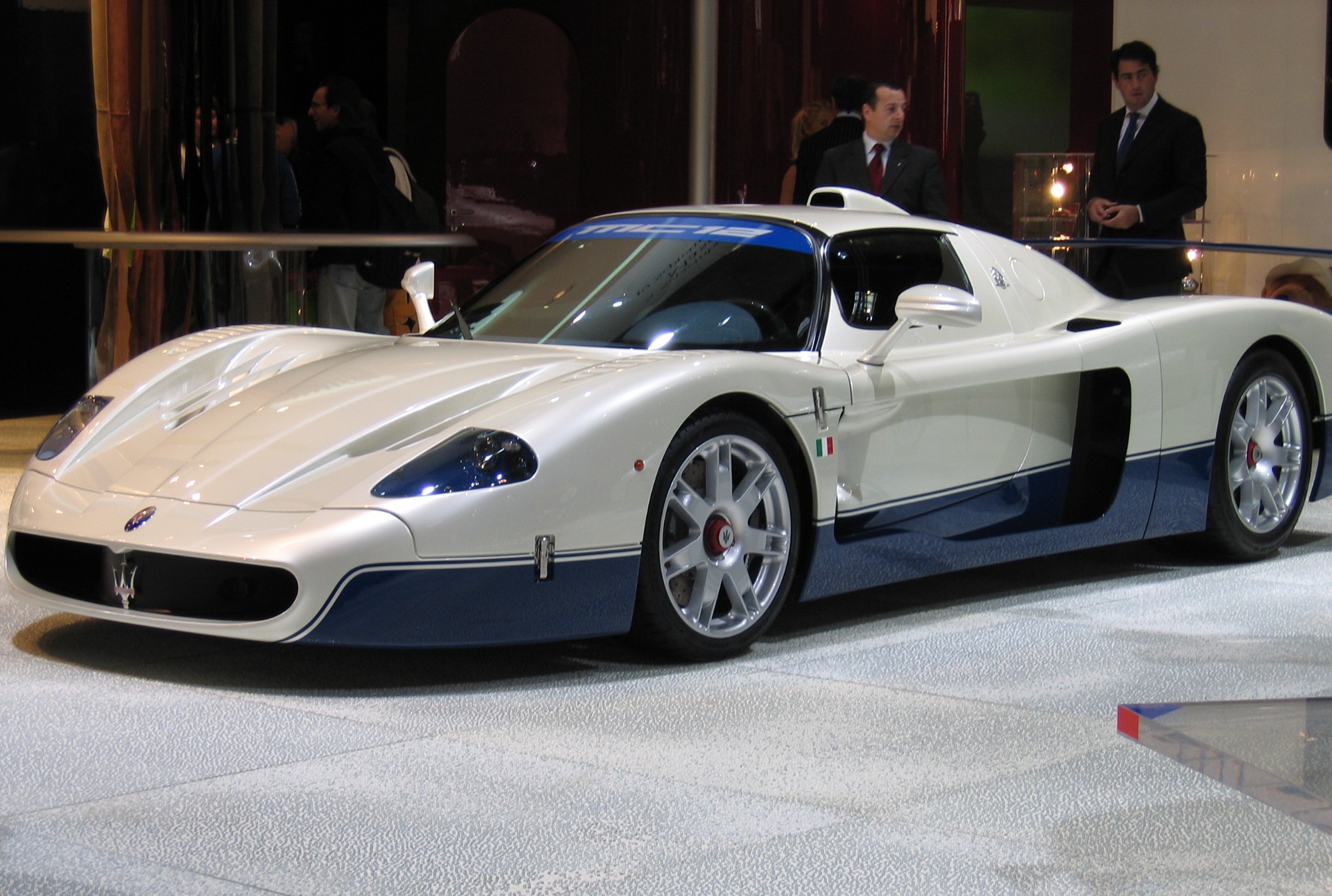
Maserati GranTurismo wallpapers
It is a customization programme based on the works on GranTurismo MC Concept. Changes include front and rear carbon-fibre spoilers, carbon fibre mirror housings and door handles, 20 inch wheel rims, carbon fibre interior (steering wheel rim, paddle shifters, instrument panel, dashboard, door panels), stiffer springs, shock absorbers and anti-roll bars with custom Maserati Stability Programme software and 10 mm (0.4 in) lower height than GranTurismo S. The programme was initially offered in GranTurismo S, with the product line expanded to all GranTurismo vehicle and all Maserati vehicles in 2009. Fifteen GranTurismo MC racecars were developed, homologated for the European Cup and National Endurance Series, one of which was taken to be raced by GT motorsport organization Cool Victory in Dubai in January, 2010.

the Maserati Gran Turismo

new Maserati GranTurismo MC

2009 Maserati GranTurismo S

Maserati GranTurismo S

Image Credits - Maserati

Maserati GranTurismo MC

Maserati GranTurismo

Maserati GranTurismo Speed Car

Visit our Maserati GranTurismo
the Maserati Gran Turismo
new Maserati GranTurismo MC
2009 Maserati GranTurismo S

Maserati GranTurismo S
Image Credits - Maserati
Maserati GranTurismo MC
Maserati GranTurismo
Maserati GranTurismo Speed Car
Visit our Maserati GranTurismo
Maserati cars Pictures and Wallpapers
granturismo
Honda’s Ito Defends Efficiency Lead as Hyundai Gains
By Makiko Kitamura and Alan OhnsmanJune 23 (Bloomberg) -- Takanobu Ito became a star at Honda Motor Co. with his work on the NSX sports car, the company’s most powerful model. Now, as chief executive officer, he’s focusing on fuel efficiency as Ford Motor Co. and Hyundai Motor Co. threaten Honda’s leading position in North America.
While Honda’s fleet is rated the most fuel-efficient in the U.S., Ford’s Fiesta subcompact gets up to 33 miles per gallon in combined city/highway driving, compared with 31 mpg for Honda’s rival Fit hatchback. Hyundai’s Sonata sedan tops Honda’s top- selling Accord in economy and horsepower, and its revamped Elantra compact promises to use less fuel than Honda’s Civic.
“Ford is coming back, and Hyundai is gaining market share,” said Tadashi Usui, an analyst at Moody’s K.K. in Tokyo. “The gap between Japanese automakers and rivals is shrinking.”
Honda, after axing its V-10 NSX supercar project in 2008, is redoubling efforts to boost fuel efficiency to fend off growing competition. Ito delayed the release of a revamped Civic compact after telling engineers he was unhappy with its size and fuel economy, said Tomohiko Kawanabe, president of Honda’s research and development unit.
Even as factors including pricing and design shape research efforts, “fuel efficiency has become the first priority in our discussions,” Kawanabe said in an interview at Honda’s research center last month in Wako, west of Tokyo.
Risking Reputation
Honda’s U.S. sales gained 13 percent in the first five months of 2010, trailing industry growth of 17 percent. Ford’s rose 31 percent in the same period, while Hyundai’s sales grew 23 percent.
Japan’s second-largest carmaker has focused on only mild improvements in fuel economy recently, risking its “green” reputation, said Ed Kim, an industry analyst at AutoPacific Inc. in Tustin, California. For example, Honda uses 5-speed automatic transmissions as the industry adopted more efficient 6-speeds, and seems reluctant to use direct-injection and turbocharging technology, Kim said.
“Even before the green thing was big, they were into green,” said Kim, a former Hyundai product planner. “Over the last few years, they’ve been completely leapfrogged in new engine technologies.”
Honda’s U.S. fleet of Honda and Acura 2009 models averaged 23.6 mpg in the U.S. Environmental Protection Agency’s fuel efficiency assessment, adjusted for real-world driving.
Hyundai- Kia group vehicles were second in the 2009 model-year survey, averaging 23.4 mpg.
Hyundai models alone, excluding those of Kia Motors Corp., exceeded Honda’s fleet with an adjusted average of 23.9 mpg, according to EPA.
Depositary Shares
Toyota Motor Corp. had an adjusted fleet average of 23.2 mpg, and Ford, with a 20.5 mpg fleet, ranked seventh.
Honda’s American depositary receipts, each representing one ordinary share, fell 9 cents to $29.90 at 4:15 p.m. in New York Stock Exchange composite trading, have dropped 12 percent this year. The shares fell 1.5 percent to close at 2,720 yen in Tokyo.
Another motivation for Honda to raise vehicle efficiency is a U.S. regulation forcing an industrywide increase by model year 2016. Honda’s fleet must average 37.4 mpg by that time, a 50 percent improvement from about 26 mpg now, John Mendel, head of Honda’s U.S. sales operation, said June 8.
The global recession following the collapse of Lehman Brothers Holdings Inc. in September 2008 also spurred Honda’s strategic shift, said Ito, who became CEO a year ago.
“In a certain sense, Lehman was a blessing,” Ito said in Tokyo last month
.
Unlike before the recession, price increases are tough to justify and vehicle size and fuel economy need to “conform to these times,” Kawanabe said.
Prius Competition
Expanding Honda’s line of hybrid cars is part of the strategy. Honda plans to introduce a new hybrid Civic with a lithium-ion battery that can store twice the power of a nickel- metal hydride battery, Kawanabe said. The company will unveil a new hybrid version of the Fit later this year.
Honda’s Insight and Civic hybrids haven’t gained ground on Toyota’s Prius, the world’s top-selling hybrid. The Prius outsold the Insight 6-to-1 in the U.S. this year through May.
One reason may be fuel economy. Toyota’s hybrid gets 51 mpg in city driving, while the Insight gets 40 mpg. Honda Executive Vice President Koichi Kondo also said the Insight, a compact model in the U.S. compared with the midsize Prius, may be too small for Americans.
The company is also exploring stop-start technology, turbochargers and expanding continuously variable transmissions to boost fuel efficiency, said Hiroshi Ataka, a Tokyo-based analyst at consulting company IHS Global Insight.
Favoring Hydrogen Power
While Honda is researching electric cars, it’s less optimistic about demand for them than Nissan is and favors hydrogen-powered cars as the ultimate zero-emission vehicle.
Honda set up a lithium-ion battery venture with GS Yuasa Corp. and can shift gears quickly if necessary, Ataka said.
The company stopped producing the NSX supercar, its fastest production model, in 2005. It planned to reintroduce it this year. Instead, it built the low-priced, sporty CR-Z hybrid that arrives in the U.S. in August.
As a young engineer Ito consulted bullet-train designers to develop an all-aluminum body for the first-generation NSX when superiors considered the notion impossible, according to a company publication.
“I love sports cars,” Ito said at the Beijing Motor Show in April. “But we have to watch the economic situation and our purse strings.”
Source;
http://www.businessweek.com/news/2010-06-23/honda-s-ito-defends-efficiency-lead-as-hyundai-gains.html
Consumer Reports: Point/counterpoint: Fresh air in new sunroof trends
Interesting take on things....
Point: More and more automakers are installing large glass roof panels that can’t be opened. If I have a big sunroof letting light in, it makes me want fresh air, too. I’m a big moonroof fan, and initially liked the idea of these larger open roofs.
But after living with several, I’ve found they’re usually too noisy to open on the highway and only really useful on back roads. Plus, if you don’t use the sunshade, they add a lot of heat in the cabin on sunny days, making the air conditioner work harder. Some of these panels-like on the Lincoln MKT and the Volkswagen Passat CC--don’t even open at all. I’d prefer automakers go back to offering smaller, normal, quiet moonroofs.
–Eric Evarts
Counterpoint: I don’t like moonroofs. Sure, they can be an occasional novelty, but I much prefer a lower purchase price, more head room, and reduced risk of problems. Plus, I like a quiet cabin where I can enjoy music or the company of my traveling companions.
For me, the trend of fixed glass tops is welcomed. Exposing more of the outside world can be wonderful on a tree-lined road or even just during balmy weather with fluffy clouds in the sky by day and stars at night. In most vehicles so-equipped, fixed glass benefits the rear passengers, creating a more open cabin feel and enhancing their enjoyment.
–Jeff Bartlett
Source;
http://blogs.consumerreports.org/cars/2010/06/pointcounterpoint-fresh-air-in-new-sunroof-trends.html
Point: More and more automakers are installing large glass roof panels that can’t be opened. If I have a big sunroof letting light in, it makes me want fresh air, too. I’m a big moonroof fan, and initially liked the idea of these larger open roofs.But after living with several, I’ve found they’re usually too noisy to open on the highway and only really useful on back roads. Plus, if you don’t use the sunshade, they add a lot of heat in the cabin on sunny days, making the air conditioner work harder. Some of these panels-like on the Lincoln MKT and the Volkswagen Passat CC--don’t even open at all. I’d prefer automakers go back to offering smaller, normal, quiet moonroofs.
–Eric Evarts
Counterpoint: I don’t like moonroofs. Sure, they can be an occasional novelty, but I much prefer a lower purchase price, more head room, and reduced risk of problems. Plus, I like a quiet cabin where I can enjoy music or the company of my traveling companions.
For me, the trend of fixed glass tops is welcomed. Exposing more of the outside world can be wonderful on a tree-lined road or even just during balmy weather with fluffy clouds in the sky by day and stars at night. In most vehicles so-equipped, fixed glass benefits the rear passengers, creating a more open cabin feel and enhancing their enjoyment.
–Jeff Bartlett
Source;
http://blogs.consumerreports.org/cars/2010/06/pointcounterpoint-fresh-air-in-new-sunroof-trends.html
The Cars.com Top 10 American-Made Cars
Cars.com's American-Made Index rates vehicles built and bought in the U.S. Factors include sales, where the car's parts come from and whether the car is assembled in the U.S. We disqualify models with a domestic parts content rating below 75 percent, models built exclusively outside the U.S. or models soon to be discontinued without a U.S.-built successor.
In today's global economy, there's no easy way to determine just how American a car is. Many cars built in the U.S., for example, are assembled using parts that come from elsewhere. Some cars assembled in the U.S. from strictly American-made parts don't sell well, meaning fewer Americans are employed to build them. Cars.com's American-Made Index recognizes cars that are built here, have a high amount of domestic parts and are bought in large numbers by American consumers.
Accord Up, F-150 Down
The Toyota Camry, which dethroned the Ford F-150 pickup in last year's AMI, remains at the top for 2010. But the No. 2 model, Honda's strong-selling Accord, surged unexpectedly. Since the AMI's 2006 inception, we've scrutinized two generations of Accords. In the past, Honda sold few imported Accords to U.S. buyers — "a percentage below 10 percent for many years," spokesman Ed Miller said — but the Accord spent several years with its domestic parts percentage in the 60s. That's not the case this year. With all Accords sold in the U.S. now assembled in either Ohio or Alabama, the Accord's 75 percent domestic content and strong sales came close to unseating Toyota for first place.
The Accord is only the most noticeable changing of the guard. Half the models in last year's AMI didn't make it back, including the venerable F-150. Blame a decline in its domestic parts content, which dropped to 55 percent for the 2010 model year. In past years the F-150 has held steady around 80 percent domestic parts content; even last year's redesign, which had the potential to change the figures, returned a respectable 75 percent rating. That's not the case anymore."
Fluctuating [parts content] figures are pretty common," Ford spokesman Mark Schirmer said. Changes in sourcing, drivetrain components or parts pricing "can make the numbers move around quite a bit."
As we move to more global sourcing," Schirmer said, "obviously the percentages change."
Ford has stayed strong on the list, however, with the Escape SUV and Focus small car slotting in at third and fourth, respectively. Although neither one made last year's AMI, both have appeared on it previously.
GM, once responsible for half the models on the AMI, is down to just one player: the Kansas-built Chevrolet Malibu, which comes in fifth place. The automaker's full-size pickups — the Chevy Silverado and GMC Sierra — were once regulars here. Production of both trucks is split between the U.S. and Mexico, however, and today's models have only a 65 percent domestic parts content.
Chrysler, whose Michigan-built Sebring landed a spot in the 2008 AMI, is back with two models. The Sebring isn't one of them, but the Michigan-built Ram 1500 pickup and Ohio-built Jeep Wrangler SUV make the list. Neither vehicle has made the AMI before. Filling in the remaining places are the Honda Odyssey, Toyota Tundra and Toyota Sienna. All three return from last year's AMI.
More Cars, Higher Content
Domestic parts content, the documenting and listing of which has been mandated by the American Automobile Labeling Act since 1994, rates the percentage by cost of a vehicle's parts that originated in the U.S. or Canada. The National Highway Traffic Safety Administration collects the figures each year, but the list alone shouldn't drive your purchase considerations. Consider the 2010 models NHTSA pegged at 90 percent, the highest percentage earned by any vehicles this model year:
For the rest of the article, follow the link;
http://www.cars.com/go/advice/Story.jsp?section=top&subject=ami&story=amMade0710
In today's global economy, there's no easy way to determine just how American a car is. Many cars built in the U.S., for example, are assembled using parts that come from elsewhere. Some cars assembled in the U.S. from strictly American-made parts don't sell well, meaning fewer Americans are employed to build them. Cars.com's American-Made Index recognizes cars that are built here, have a high amount of domestic parts and are bought in large numbers by American consumers.Accord Up, F-150 Down
The Toyota Camry, which dethroned the Ford F-150 pickup in last year's AMI, remains at the top for 2010. But the No. 2 model, Honda's strong-selling Accord, surged unexpectedly. Since the AMI's 2006 inception, we've scrutinized two generations of Accords. In the past, Honda sold few imported Accords to U.S. buyers — "a percentage below 10 percent for many years," spokesman Ed Miller said — but the Accord spent several years with its domestic parts percentage in the 60s. That's not the case this year. With all Accords sold in the U.S. now assembled in either Ohio or Alabama, the Accord's 75 percent domestic content and strong sales came close to unseating Toyota for first place.
The Accord is only the most noticeable changing of the guard. Half the models in last year's AMI didn't make it back, including the venerable F-150. Blame a decline in its domestic parts content, which dropped to 55 percent for the 2010 model year. In past years the F-150 has held steady around 80 percent domestic parts content; even last year's redesign, which had the potential to change the figures, returned a respectable 75 percent rating. That's not the case anymore."
Fluctuating [parts content] figures are pretty common," Ford spokesman Mark Schirmer said. Changes in sourcing, drivetrain components or parts pricing "can make the numbers move around quite a bit."
As we move to more global sourcing," Schirmer said, "obviously the percentages change."
Ford has stayed strong on the list, however, with the Escape SUV and Focus small car slotting in at third and fourth, respectively. Although neither one made last year's AMI, both have appeared on it previously.
GM, once responsible for half the models on the AMI, is down to just one player: the Kansas-built Chevrolet Malibu, which comes in fifth place. The automaker's full-size pickups — the Chevy Silverado and GMC Sierra — were once regulars here. Production of both trucks is split between the U.S. and Mexico, however, and today's models have only a 65 percent domestic parts content.
Chrysler, whose Michigan-built Sebring landed a spot in the 2008 AMI, is back with two models. The Sebring isn't one of them, but the Michigan-built Ram 1500 pickup and Ohio-built Jeep Wrangler SUV make the list. Neither vehicle has made the AMI before. Filling in the remaining places are the Honda Odyssey, Toyota Tundra and Toyota Sienna. All three return from last year's AMI.
More Cars, Higher Content
Domestic parts content, the documenting and listing of which has been mandated by the American Automobile Labeling Act since 1994, rates the percentage by cost of a vehicle's parts that originated in the U.S. or Canada. The National Highway Traffic Safety Administration collects the figures each year, but the list alone shouldn't drive your purchase considerations. Consider the 2010 models NHTSA pegged at 90 percent, the highest percentage earned by any vehicles this model year:
For the rest of the article, follow the link;
http://www.cars.com/go/advice/Story.jsp?section=top&subject=ami&story=amMade0710
Toyota’s Top Test Driver Naruse Killed in Car Crash in Germany
June 24 (Bloomberg) -- Toyota Motor Corp.’s chief test driver, Hiromu Naruse, was killed in a car accident yesterday in Germany, the world’s largest automaker said.Naruse, 67, died following the accident near a test track, the New York Times reported yesterday, citing the German newspaper Rhein-Zeitung. A Bayerische Motoren Werke AG vehicle driven by another test driver was involved in the accident, the cause of which is still unclear, according to the report.
“We are surprised by the sudden sad news,” Mieko Iwasaki, a Tokyo-based spokeswoman for Toyota, said by phone today. “We express our heartfelt sympathy to people who were in the accident.” Iwasaki declined to comment on the details of the accident pending an investigation.
Naruse joined the Toyota City, Japan-based carmaker in 1963 and was involved in developing sports cars including the 2000GT and Lexus LFA, according to the Times report.
Source;
http://www.businessweek.com/news/2010-06-24/toyota-s-top-test-driver-naruse-killed-in-car-crash-in-germany.html
Subscribe to:
Posts (Atom)